Open-weight
VRAM and GGUF
VRAM is driven by weight footprint, a KV cache that grows with context length, and runtime overhead. GGUF is a common container for quantized local weights. This page explains that relationship and cites official context/parameter figures. It does not invent per-model gigabyte ratings.
What makes up VRAM?
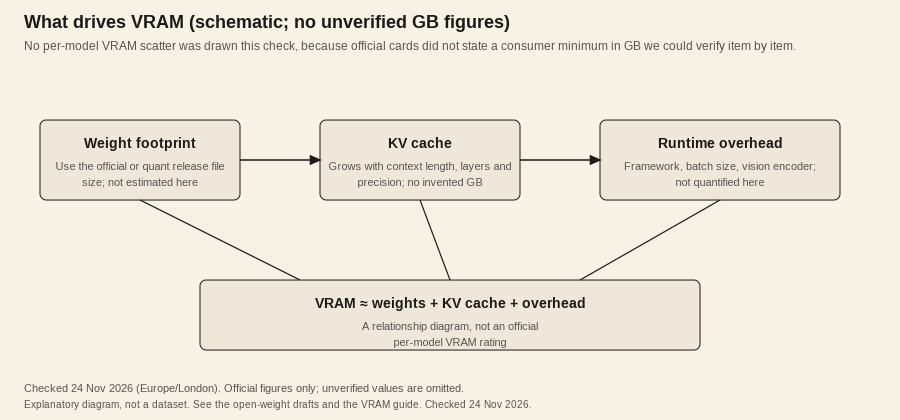
Insert vram-formula-schematic.en.svg. In words:
VRAM ≈ weight footprint (including a published quantized file size) + KV cache + runtime overhead.
- Weights: use the file size on the official repo or on that quant release page. Precision (FP16 / FP8 / FP4 / integer quants) changes the footprint. DeepSeek-V4’s card states MoE expert parameters in FP4 and most other parameters in FP8 Mixed — a precision note, not a GB figure.
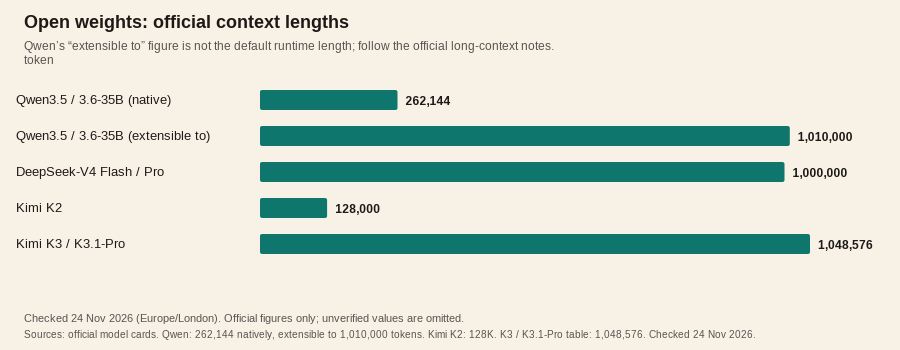
- KV cache: grows with context length, depth, batch size and precision. Official lengths (Qwen3.5 native 262,144, extensible to 1,010,000; Kimi K2 128K; Kimi K3 / K3.1-Pro 1,048,576; DeepSeek-V4 1M) are token windows, not VRAM.
- Runtime overhead: framework, vision encoder, GPU context. Official cards rarely give a single GB for this, so this page does not estimate one.
A large parameter count does not automatically mean “cannot run locally”, and a small model at maximum context can still fill the cache. Where official cards omit a consumer VRAM floor, this site marks it unverified.
What is GGUF, and how does it relate to official weights?
GGUF is a weight-container format used in the llama.cpp ecosystem. It is not a licence and not automatically an official release:
- Official weights may be safetensors or an official quant — follow that model card.
- Community GGUF files are third-party conversions. Their size and quality belong on that file’s page; they are not copied here unverified.
- Quantization shrinks weights and may change quality. This page has not compared quality and does not claim “Q4 equals the official model”.
- The licence follows the base model version, plus anything the quant publisher states. Community weight edits, including refusal-reducing edits, inherit the base licence.
Tools such as Ollama or LM Studio pull or convert models; follow their official docs. The site’s Ollama tool page covers the product and cloud unit prices, not a VRAM chart.
Official parameters and context (not a VRAM table)
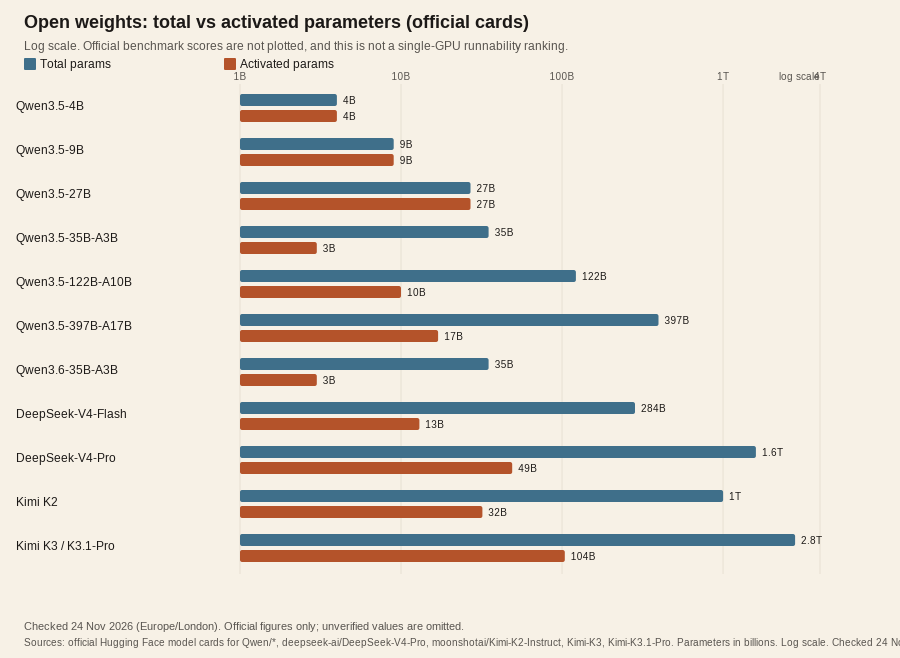
Insert the parameter and context charts. Full rows live on the open-weight comparison page. Two facts worth repeating:
- For MoE models, activated parameters are much smaller than total parameters (e.g. Qwen3.5-35B-A3B: 35B / 3B; DeepSeek-V4-Pro: 1.6T / 49B; Kimi K3: 2.8T / 104B). Activated count affects per-token compute; storage may still need the expert weights. Offloading behaviour is documented by the official repo or the serving framework — this page does not say “only 3B VRAM is required”.
- “Extensible” context must be enabled as the official card describes; the default is the native window.
Frequently asked questions
Is there an 8GB / 16GB / 24GB lookup table?
Not in this check: official cards did not state consumer floors we could verify row by row, so there is no scatter chart of VRAM vs parameters either. Use official file sizes and test at your target context length.
How much VRAM does a GGUF Q4 or Q5 need?
It depends on that file’s actual size and the context you set. Third-party calculator outputs are not cited here.
DeepSeek-V4 says the KV cache is 10% of V3.2 — is that a GB figure?
The official card gives a ratio versus V3.2 in the 1M-token setting (about 10% KV cache and 27% single-token FLOPs for Pro). It does not convert that into an absolute GB this page can put in a table.
Will this English page explain abliteration?
Only as a short technical pointer: it is a class of weight edits that can reduce refusal behaviour; quality may change; the base licence still applies. No explicit content and no instructions for unlawful use. A longer guide is planned but is not published in this batch. The Chinese edition does not use that topic as an acquisition heading.
Sources and updates
Checked 24 Nov 2026 (Europe/London). Specifications are from official cards linked on the comparison draft. “GGUF” is a format description, not an endorsement of a particular quantized file. Some drafting was AI-assisted and needs a human pass.
Newsletter
Subscribe for open-weight release and availability updates
One changelog email a week, written for developers: official prices, model launches or withdrawals, and availability. A new list price is not a price drop. Unsubscribe anytime. This is not a paid or affiliate call-to-action.
The newsletter provider is not connected yet. This form is a placeholder and does not submit any data. There is no backend and there are no keys.